How Immigration Advisers Can Help Clients Stand Out in Competitive Interviews
Introduction: Why Good Candidates Still Miss Out Many migrants attend interviews fully qualified for the role, yet still struggle to secure job offers. Often, the issue is not experience or technical ability.
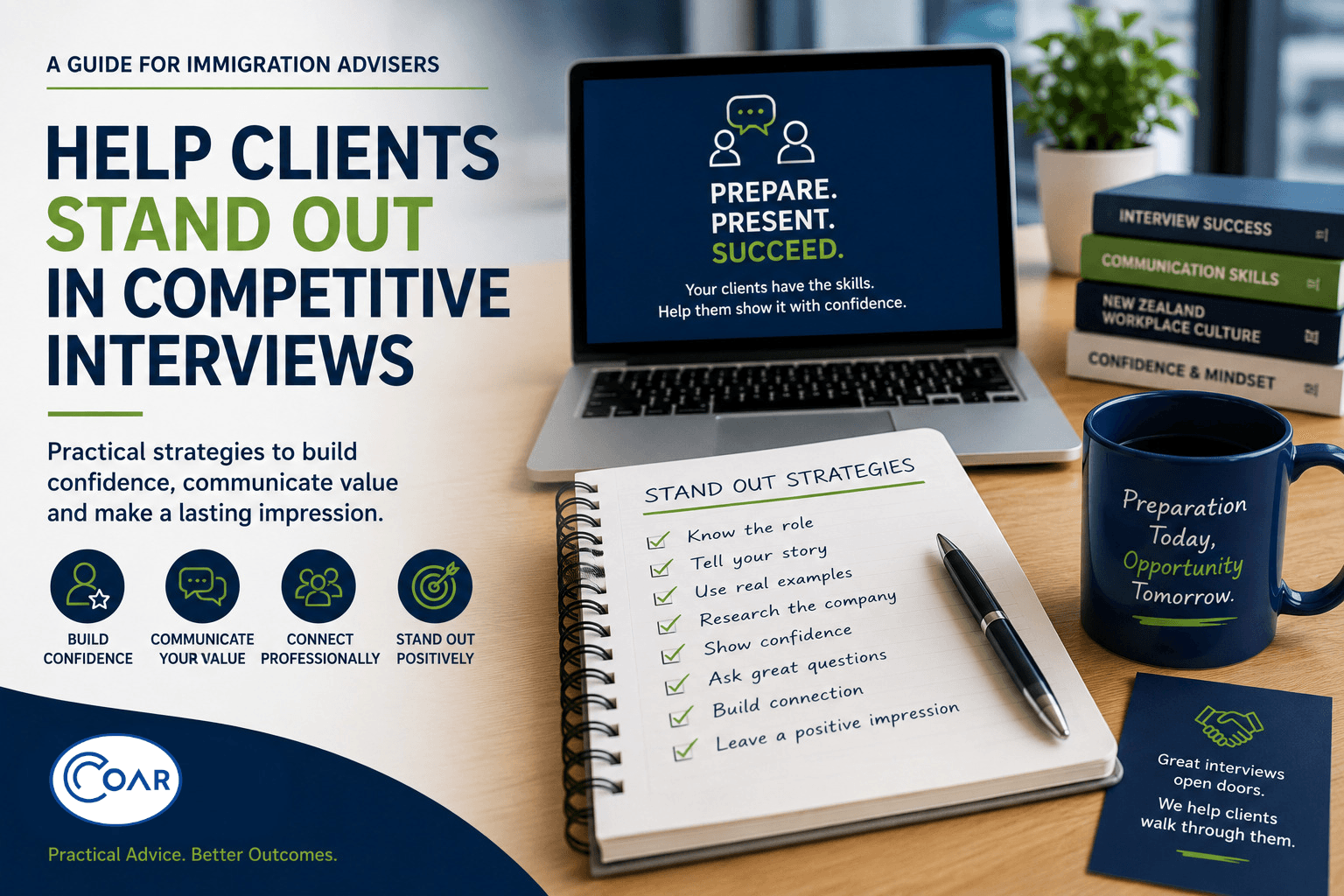
Instead, candidates may struggle to:
Communicate confidence
Explain their value clearly
Understand NZ interview expectations
Build rapport with employers
Present themselves professionally under pressure
In competitive job markets, employers are often interviewing multiple candidates with similar qualifications.
The candidates who stand out are usually the ones who communicate professionalism, confidence, and genuine connection most effectively.
For immigration advisers supporting employment outcomes, helping clients understand how to stand out positively during interviews can make a significant difference.
What NZ Employers Are Really Looking For
Many migrants assume interviews are only about technical skills.
In reality, NZ employers often place strong importance on:
Communication
Attitude
Professionalism
Teamwork
Reliability
Adaptability
Cultural fit
Confidence
Employers are not only asking:
“Can this person do the job?”
They are also asking:
“Will this person fit well into our workplace?”
Understanding this helps clients prepare more effectively.
Step 1: Help Clients Build Confidence Before the Interview
Confidence strongly influences interview performance.
Unfortunately, many migrants:
Undervalue their experience
Focus too heavily on weaknesses
Assume overseas experience is less valuable
Become intimidated by local candidates
This can lead to hesitant communication and weak self-presentation.
Immigration advisers can help by encouraging clients to:
Recognise transferable skills
Speak positively about achievements
Practice answers aloud
Prepare examples in advance
Focus on strengths rather than limitations
Confidence often improves with preparation and reassurance.
Step 2: Teach Clients to Tell Their Story Clearly
One of the biggest interview challenges is explaining experience in a clear and engaging way.
Many candidates:
Ramble
Speak too vaguely
Jump between topics
Give overly short answers
Encourage clients to structure answers clearly and professionally.
Strong answers often include:
Situation or context
What they did
Skills used
Positive outcome
Clear storytelling helps employers remember candidates more easily.
Step 3: Encourage Clients to Use Real Examples
Generic answers rarely stand out.
NZ employers often prefer practical examples that demonstrate:
Problem-solving
Communication
Teamwork
Leadership
Customer service
Adaptability
Weak Answer:
“I work well under pressure.”
Stronger Answer:
“In my previous role, we experienced unexpected staff shortages during a busy period. I helped reorganise priorities, supported team members, and ensured customer deadlines were still met successfully.”
Specific examples feel more genuine and credible.
Step 4: Help Clients Understand Body Language and Presentation
First impressions form quickly during interviews.
Employers often notice:
Eye contact
Facial expressions
Posture
Tone of voice
Energy and engagement
Professional appearance
Some migrants may come from cultures with different communication styles, which can affect interview confidence.
Encourage Clients To:
Smile naturally
Maintain professional eye contact
Sit confidently
Speak clearly
Avoid overly quiet responses
Show enthusiasm for the role
Professional presence can strongly influence employer perception.
Step 5: Teach Clients to Research the Company Properly
Candidates who understand the company often stand out immediately.
Research helps clients:
Answer questions more confidently
Show genuine interest
Tailor responses effectively
Ask stronger questions
Encourage clients to review:
The company website
Services or products
Company values
Recent news or updates if available
The job description carefully
Preparation demonstrates professionalism.
Step 6: Help Clients Ask Good Questions
Many migrants underestimate how important this stage of the interview can be.
Thoughtful questions show:
Interest
Preparation
Confidence
Professional engagement
Good Questions Include:
What does success look like in this role?
What are the biggest priorities for the team currently?
What training opportunities are available?
What do you enjoy most about working here?
Questions help create a more natural conversation rather than a one-sided interview.
Step 7: Encourage Professional Enthusiasm
Some candidates focus so heavily on “sounding professional” that they appear overly formal or emotionally disconnected.
NZ workplaces generally appreciate:
Warmth
Positivity
Approachability
Genuine enthusiasm
Clients do not need to be overly energetic or extroverted.
But showing interest in the role and company can make a strong impression.
Step 8: Help Clients Handle Difficult Questions Calmly
Competitive interviews often include challenging questions about:
Employment gaps
Visa status
Lack of NZ experience
Career changes
Weaknesses
Difficult workplace situations
Immigration advisers can help clients prepare calm, professional responses that:
Stay positive
Focus on solutions
Highlight adaptability
Avoid defensiveness
Preparation reduces panic during difficult moments.
Step 9: Explain That Interviews Are Also About Connection
Many migrants approach interviews like exams.
But interviews are also about relationship-building.
Employers often remember candidates who:
Communicate naturally
Build rapport
Listen carefully
Show professionalism
Create a positive interaction
Human connection matters.
Common Mistakes That Prevent Clients From Standing Out
Immigration advisers often see candidates:
Over-apologise for lack of NZ experience
Speak negatively about previous employers
Give memorised robotic answers
Focus too heavily on sponsorship needs
Undersell their strengths
Fail to prepare examples
Avoid asking questions
These issues can quietly weaken otherwise strong candidates.
How Immigration Advisers Can Create More Value
Providing interview support can significantly strengthen client outcomes.
Helping clients stand out professionally can:
Increase interview success rates
Improve confidence
Strengthen settlement outcomes
Build trust and referrals
Differentiate immigration services from competitors
Employment success is often one of the most important parts of a migrant’s long-term stability in New Zealand.

Final Thoughts
Standing out in interviews is not about being the loudest or most experienced candidate.
It is about communicating:
Confidence
Professionalism
Clarity
Adaptability
Genuine interest
Strong interpersonal skills
Many migrants already have the qualifications and experience employers need, they simply need support presenting themselves effectively in competitive interview environments.
By helping clients improve communication, preparation, and confidence, immigration advisers can play a powerful role in helping migrants succeed professionally and build stronger futures in New Zealand.